
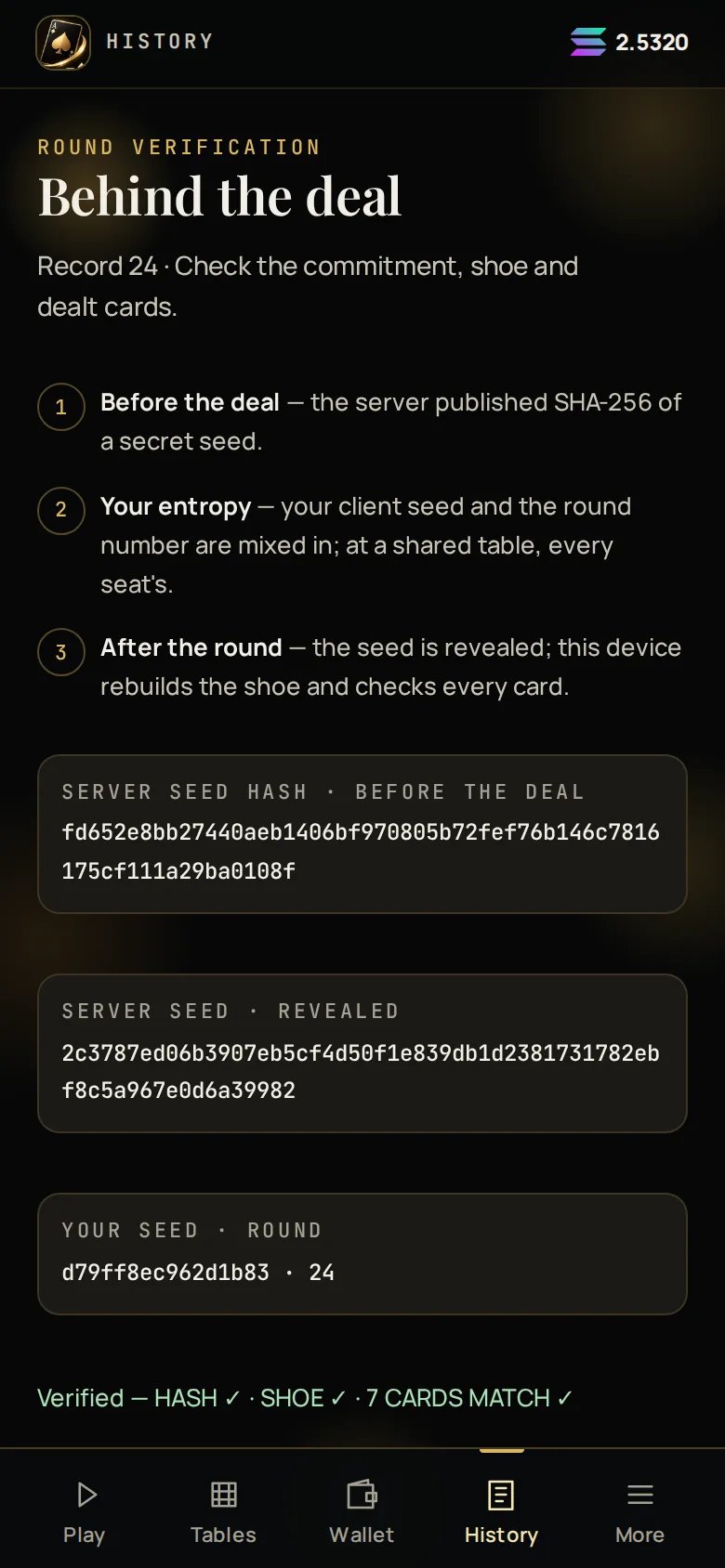
The three steps
1
Commit — before the deal
The server generates a random 32-byte server seed and publishes
SHA-256(serverSeed). That hash is the commitment, and you can see it while
the round is still live.A hash cannot be worked backwards, so the commitment tells you nothing about
the shuffle. But the server can no longer change the seed without the hash
failing to match.2
Deal
The shoe is derived from three inputs:
- the server seed (secret until the round ends)
- your client seed (yours, and visible to you the whole time)
- the round’s nonce (a counter)
3
Reveal — after settlement
The server seed is published. Now anyone can:
- hash it and check it equals the commitment from step 1
- re-run the derivation and check it produces the exact cards that were dealt
What you actually see
On a verified round you get three checks:- HASH — the revealed seed hashes to the commitment that was published before the deal.
- SHOE — the derivation reproduces the shoe.
- CARDS MATCH — every one of the 312 cards is in the position the round dealt from.
The check runs in your browser
This is the part that matters. The verification is not the server telling you it was fair — the Mini App and the public verify page carry their own implementation of the shuffle, in WebCrypto, and re-derive the shoe locally. The server is never asked to vouch for itself.The browser implementation and the server implementation are tested against
each other on every build: they must reproduce the same 312 cards on unlike
seed sets and produce the same commitment hash. If they ever diverged, the
build would fail.
What this does and does not prove
It proves the cards dealt in a round came from a shoe fixed before the deal, and that nobody changed them mid-hand to your disadvantage. It does not prove the house edge is what we say it is — that is a property of the rules, measured by simulation and printed. Nor does it stop you losing. A fair shuffle is still a shuffle.Related
Verify a round
Step by step, on a hand you actually played.
Your client seed
The part of the shuffle that is yours.