
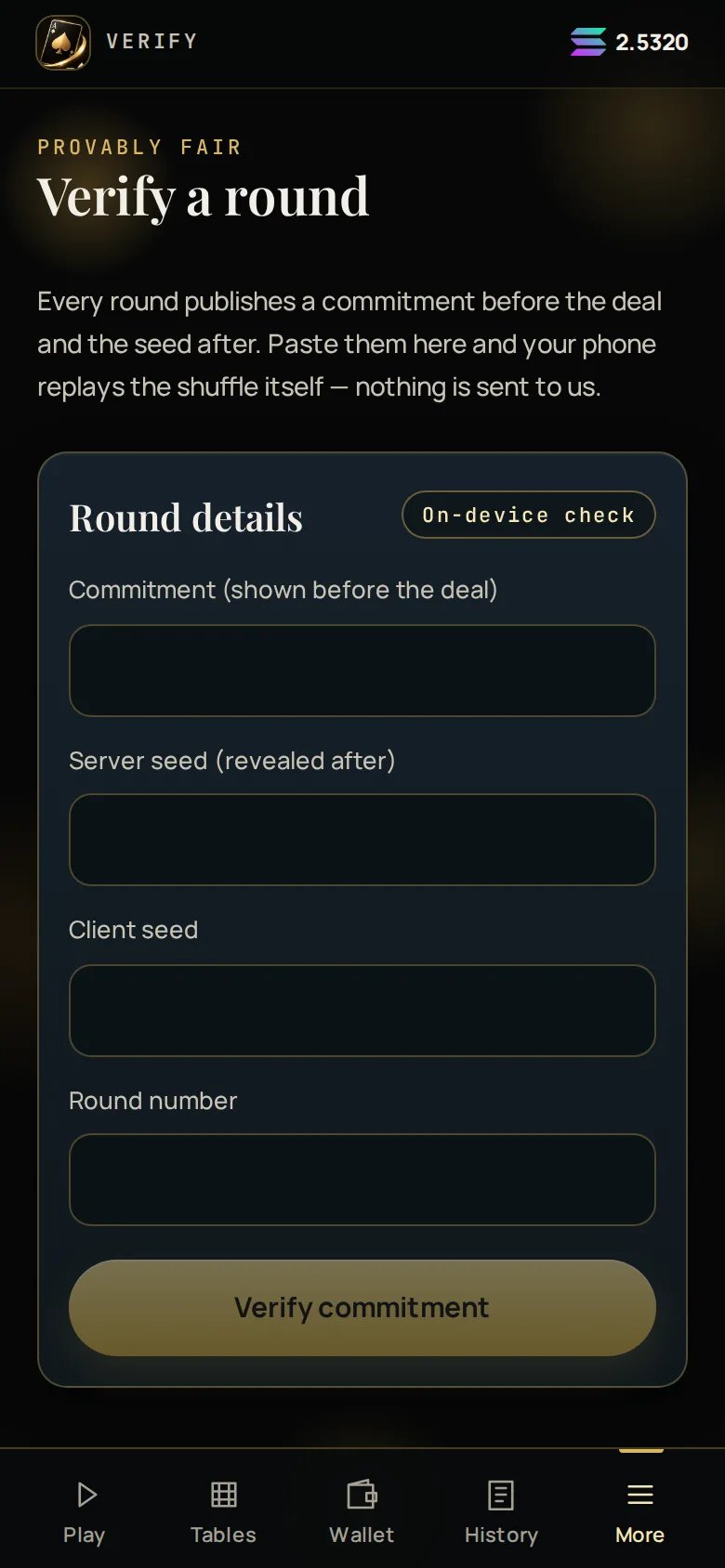
From the app
1
Open the round
History → the round, or Verify hand straight from a result panel.
2
Read the three values
The round shows its commitment, the revealed server seed, your
client seed and the nonce.
3
Check
The page re-derives the shoe in your browser and reports:All three have to pass. One failing is a failure.
The public page
aceupgame.com/verify is a standalone verifier that needs no login and no account at all. It takes four values — the commitment, the server seed, the client seed and the nonce — all of which the round screen in the app shows you. Paste them in and it re-derives the shoe in your browser and reports whether the hash and the cards match. Because it needs nothing but those four values, you can hand them to anybody. A person with no Ace Up account can check your hand on their own machine, and they do not have to take our page’s word for it either — the algorithm is below. This is also what a group’s/fair command links to.
Verifying it by hand
You do not have to use our page. The algorithm is small enough to reimplement:1
Check the commitment
2
Rebuild the shoe
Build a fresh six-deck shoe in the canonical order: deck-major, then suit,
then rank — 6 × 52 = 312 cards.Then run an unbiased Fisher–Yates shuffle over it, drawing 32-bit values from
an HMAC-SHA256 keystream keyed on the server seed and taking the client
seed and nonce as its message.“Unbiased” means rejection sampling: a value at or above
floor(2³² / max) × max is discarded and redrawn, so no card position is
even slightly favoured by the modulo.3
Compare
Deal from the top of your shoe in the order the round shows, and compare
card for card.
If a check fails
Report it through /support with the round number. A failing check is the one bug class that matters most here, and it is treated that way. Before you do, the two things that produce a false alarm:- Comparing against a different round’s seed. The nonce has to match.
- A round that is still live. The server seed is not published until the round settles — that is the whole point of the commitment.
Related
How the commitment works
Commit, deal, reveal — in more detail.