
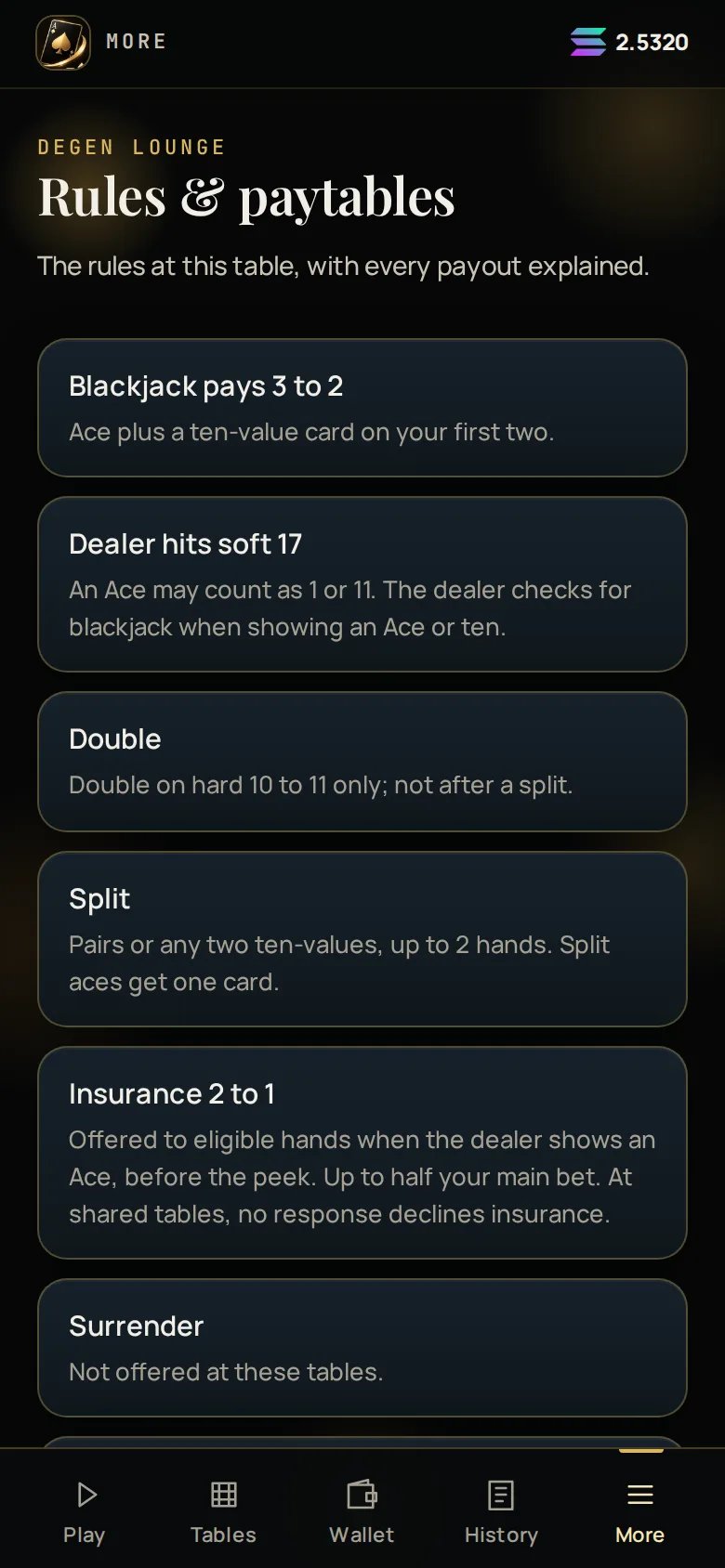
The rule set
The house edge
0.89% on the main hand. Measured on Ace Up’s own engine over 9,000,000 simulated rounds of basic strategy — not copied from a chart (rules v6, since 15 September 2026; the double and split rules above are what moved it from the 0.49% of the first rule set). It is the share of everything wagered that the house keeps on average, across a very large number of hands. For comparison, blackjack at other crypto casinos sits around 0.5%, and the house-built games most of them push — crash, dice, plinko — typically charge 1%. We are in line with the first and well under the second. There is no rake and no table fee. The edge is the only thing the house earns from a hand.Side bets, and their edges
Side bets are optional and they are expensive. Ace Up prints their edges on the rules screen for the same reason it prints the main one.
That is about seven times the main hand. Each side bet is capped at 20% of
your main bet. They are a fun bet, not a good one,
and pretending otherwise is what cheap casinos do.
Full paytables are on Side bets.
Why reshuffling every round matters
The shoe is rebuilt and reshuffled for every single round. Two consequences:- Card counting does not work here. There is no count to carry and no penetration to exploit. This is not a countermeasure bolted on — it falls out of deriving the shoe from the round’s own seed.
- No hand owes anything to the last one. A losing streak does not make the next hand more likely to win, and a winning one does not make it less. Each round is dealt from a fresh six-deck shoe.
Six decks, not infinite
An infinite deck would add roughly 0.06% to the house edge and would read as a video-slot gimmick. Six decks is what a real blackjack table uses, and the side-bet paytables above are the standard six-deck ones.Related
Side bets
Perfect Pairs and 21+3, with the full paytables.
Provably fair
How the shuffle is committed before the deal.